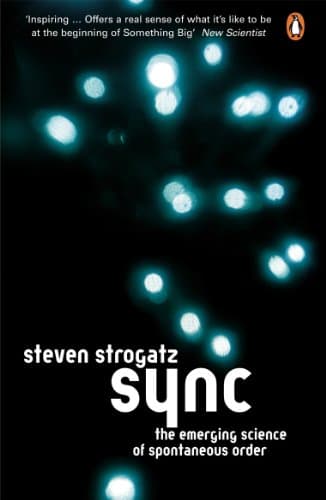
Sync: The Emerging Science of Spontaneous Order (Penguin Press Science)
From Publishers Weekly Strogatz is a Cornell mathematician and pioneer of the science of synchrony, which brings mathematics, physics and biology to bear on the mystery of how spontaneous order occurs at every level of the cosmos, from the nucleus on up. In this eminently accessible and entertaining book, Strogatz explores the mysterious synchrony achieved by fireflies that flash in unison by the thousands, and the question of what makes our own body clocks synchronize with night and day and even with one another. He explores the sync of inanimate objects, inadvertently discovered by Christiaan Huygens in 1665 when he observed that his two pendulum clocks would swing in unison when they were within a certain distance of each other. A case of spontaneous synchrony occurred on the 2000 opening of the Millennium footbridge in London when hundreds of pedestrians caused the bridge to undulate erratically as they unconsciously adjusted their pace to the bridge's swaying-it was closed two days later. Strogatz explores synchrony in chaos systems, at the quantum level, in small-world networks as exemplified by the parlor game "six degrees of Kevin Bacon" and in human behavior involving fads, mobs and the herd mentality of stock traders. The author traces how the isolated and often accidental discoveries of researchers are beginning to gel into the science of synchrony, and he amply illustrates how the laws of mathematics underlie the universe's uncanny capacity for spontaneous order.Copyright 2003 Reed Business Information, Inc. --This text refers to an alternate
- ASIN
- B002RI9XBU
- Embedding
- CLIP ViT-L/14 · 768d
- Distance metric
- cosine
- Doc fetch
- 2mscache hitGET /v2/namespaces/amazon-products/documents/B002RI9XBU
- Similar query
- 31msre-embed title → /query
Doc fetch goes through Layer's Aerospike pull-through cache; cache hit served the row without touching turbopuffer. The similar query re-embeds this product's title with CLIP-text and runs a vector query — queries don't go through the doc cache, so no cache header is set.
Search inside customer reviews
You might also like